Archives
-
Journal of Advances in Military Studies
Vol. 9 No. 1 (2026) -
Journal of Advances in Military Studies
Vol. 8 No. 2 (2025) -
Journal of Advances in Military Studies
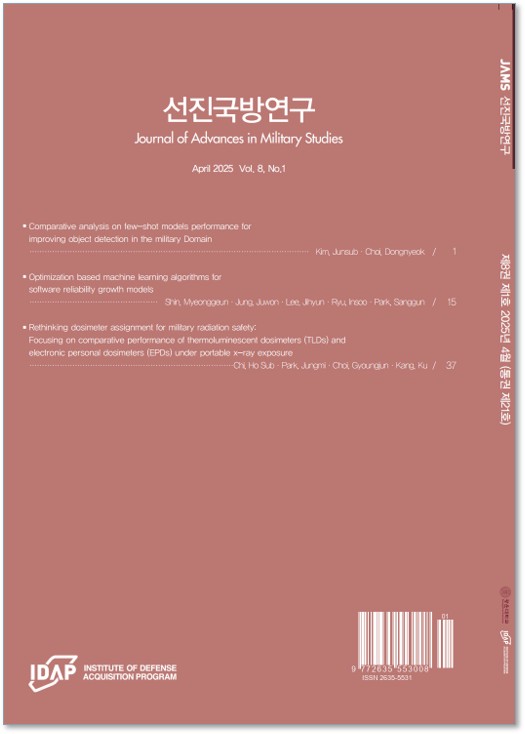
Vol. 8 No. 1 (2025)The April 2025 issue of the Journal of Advances in Military Studies (JAMS) published three studies.
According to Kim and Choi (2025)' study, it evaluates the effectiveness of Few-Shot Object Detection (FSOD) models for military applications, addressing data scarcity and security constraints. A military vehicle image dataset was used to fine-tune four models—YOLO, DETR, GLIP, and CD-ViTO—under 1-shot, 5-shot, and 10-shot settings. Among them, CD-ViTO showed the highest performance and strong cross-domain generalization, confirming FSOD's potential for accurate object detection in military contexts.
Shin, Jung, Lee, Ryu, and Park (2025) proposes using diverse optimization-based machine learning algorithms to enhance the accuracy of Software Reliability Growth Models (SRGMs), especially for defense applications. Results highlight large performance variations depending on the algorithm, demonstrating the limitations of single-method approaches and emphasizing the importance of diverse optimization strategies for more reliable software prediction.
Lastly, in the study of Chi, Park, Choi, and Kang (2025), it compares thermoluminescent dosimeters (TLDs) and electronic personal dosimeters (EPDs) for military use under portable X-ray exposure. While TLDs offer accurate cumulative dose tracking, they fail at longer distances and low pulse levels. In contrast, EPDs detect radiation reliably across all conditions and provide real-time feedback, making them more suitable for field-based military radiation monitoring. Results support revising current dosimetry practices to enhance radiation safety in military operations.
-
Journal of Advances in Military Studies
Vol. 7 No. 3 (2024) -
Journal of Advances in Military Studies
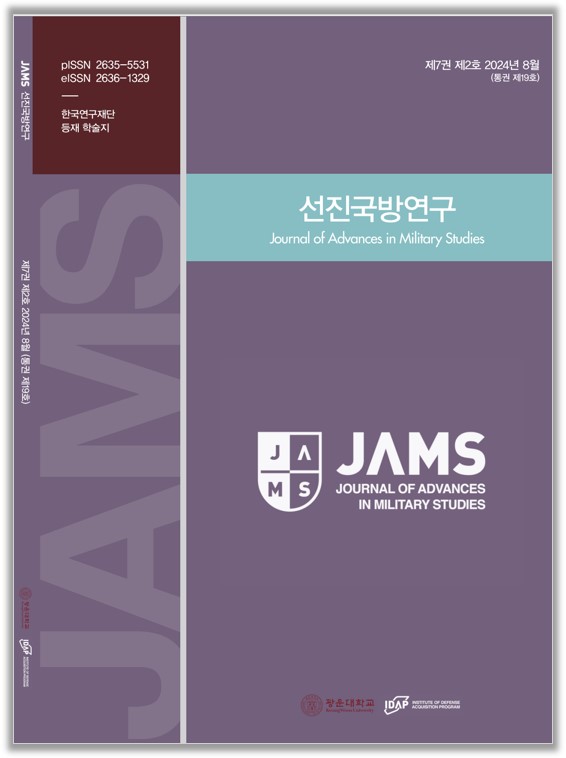
Vol. 7 No. 2 (2024)The August 2024 issue of the Journal of Advances in Military Studies (JAMS) published two studies.
Jeong and Park (2024) examined how Ukraine strategically used narratives focused on "democratic values and identity" to effectively counter Russia’s aggression during the 2022 Russo-Ukrainian War. It analyzed how these narratives garnered international support and solidarity among state and non-state actors. The research also proposed an analytical framework to explain the narrative's impact on Ukraine’s ability to sustain the conflict with Russia.
In the study of Kim, Kim, Jeong (2024), the research examined the feasibility of implementing Condition-Based Maintenance Plus (CBM+) in weapon systems using sensor data. It demonstrated successful data collection from engine components, enabling real-time monitoring. Key foundational elements for CBM+ adoption, such as data networks, security, and standardization, were analyzed.
-
Journal of Advances in Military Studies
Vol. 7 No. 1 (2024)The April 2024 issue of the Journal of Advances in Military Studies (JAMS) published three studies. Ra et al.(2024) explored the importance of improving PPG measurement accuracy in military smartwatches used by soldiers. It highlighted factors like physical condition and environmental influences that contributed to errors. Accurate health data is crucial for soldier safety and operational performance during intense activities, emphasizing the need for enhanced wearable technology. Kim and Lee (2024) examined the use of 4th Industrial Revolution technologies like AI, IoT, and big data for smart underground ammunition depots. It prioritized factors such as safety and logistics through AHP analysis, emphasizing the need for strengthened safety systems and efficient monitoring. Nam et al. (2024) investigated the effect of hair and beards on gas mask airtightness, using a SMARTMAN mannequin for testing. Results showed that the presence of hair and beards reduces the mask's effectiveness, with optimal sizing being crucial for maintaining airtightness. These findings contributed to improving gas mask performance and military readiness against chemical and biological threats. -
Journal of Advances in Military Studies
Vol. 6 No. 3 (2023)The December 2023 issue of the Journal of Advances in Military Studies (JAMS) published four studies regarding three types of research.
At first, Empirical Article type, Kim and Kim (2023) suggested an improvement plan of current continuing education program for military personnel, a key human resource in the field of army administration, to increase the learning effect through diagnosis of the educational status, survey, and interview method. (https://doi.org/10.37944/jams.v6i3.201)
As the second type of Case Reports, Cho and Kim (2023) on military airport relocation raised the need to secure new airfield for flight tests of military aviation systems and proposed a flight test airfield with the most reasonable alternative through expert interviews. (https://doi.org/10.37944/jams.v6i3.215)
Thirdly, in section of Methodologies and Methods, to explore tactical drone operations as weapon system, Kim and Cho (2023) conducted a spatiotemporal analysis using Armed Conflict Location and Event Data (ACLED) in recent Russia-Ukraine war. (https://doi.org/10.37944/jams.v6i3.230)
In addition, Bae and Lee (2023) suggested the use of transfer learning and fine-tuning techniques as a way to improve the reliability of artificial intelligence (AI) models for the classification of military objects with representative ground weapon systems in Republic of Korea. (https://doi.org/10.37944/jams.v6i3.216)----------------------------------------------------------------------------------------------------------------
선진국방연구 JAMS(Journal of Advances in Military Studies) 2023년 12월호에 4개 논문이 발행되었습니다.
첫 번째의 실증 논문 유형은 국방 행정 분야의 핵심 인적자원인 육군 군무원 대상으로 직무역량과 전문성 강화를 위한 현행 보수교육의 교육실태 진단하고 학습효과를 높이기 위한 개선 방안을 제안하였다.
두 번째의 사례연구 유형은 향후 유무인 항공체계 발전에 따른 계획된 체계개발 추진에 필요한 군용 항공체계의 비행시험을 위한 전용 비행장 확보의 필요성을 제기하고 관련 분야 전문가 면담을 통해 비행시험 전용 비행장의 실현가능한 확보방안을 도출하였다.
세 번째의 방법론 유형은 다음과 같다. (1) 최근 러시아-우크라이나 전쟁에서 활용되고 있는 드론 운영에 관한 무기체계 운용지역, 효율성 등을 분쟁지역 데이터(ACLED)를 활용하여 시공간적 분석을 수행하였다. (2) 지상 무기체계 분류의 신뢰성을 향상시키기 위한 인공지능 모델의 개선방법으로 전이학습과 미세조정 기술 활용을 제시하였다. -
Journal of Advances in Military Studies
Vol. 6 No. 2 (2023)The August 2023 issue of the Journal of Advances in Military Studies (JAMS) published ten studies, and four research type of studies were contained. As the first type of Empirical articles, four studies related to Defense & Military management (underwater defense system in anti-torpedo tactic, jet fighter performance improvement, appropriate estimation of reserve forces, and effect of educational intervention with instructor’s coaching behavior) were presented. As the second type of Methodologies and Methods section, a study on regarding lifetime prediction and analysis of GaN RF semiconductors was included. In Case reports section, three analysis results were derived from the following cases: (1) patent analysis of wheeled armoured vehicle, (2) North Korea’s reaction to ROK-U.S. Joint Military Exercises, (3) inter-Korean health and medical cooperation in the spread of infectious diseases in border region. Lastly, in terms of Systematic review and Meta-analysis articles, two review studies on the trend in object detection from drone using deep learning network and analytical methods (ELISA and cytotoxicity analysis) for the biological toxins were released.
=================================================================
선진국방연구 JAMS(Journal of Advances in Military Studies) 2023년 8월호는 10개 연구(4개 연구 유형)가 발행되었습니다. 첫 번째의 실증 논문 유형은 국방 및 군사 관리와 관련된 4개의 연구(대폭격전술의 수중 방어 시스템, 제트 전투기 성능 향상, 예비군의 적절한 추정, 교관의 코칭 행동을 통한 교육 개입 효과)가 제시되었습니다. 두 번째 유형의 방법 및 방법 섹션은 GaN RF 반도체의 수명 예측 및 분석에 관한 연구가 수록되었습니다. 사례 보고 섹션에서는 (1) 바퀴 달린 장갑차의 특허 분석, (2) 한미 연합 군사 훈련에 대한 북한의 반응, (3) 접경 지역의 전염병 확산에 대한 남북 보건 의료 협력 등 3가지 분석 결과가 도출되었습니다. 끝으로 체계적 검토 및 메타 분석 유형의 논문은 딥러닝 네트워크를 활용한 드론 물체 탐지와 생물학적 독소에 대한 분석 방법(ELISA 및 세포 독성 분석) 동향 연구가 발표되었습니다.
-
Journal of Advances in Military Studies
Vol. 5 No. 3 (2022)The December 2022 issue of the Journal of Advances in Military Studies (JAMS) contains eight studies that attempted to verify defense & military management (region innovational system, national industry) and technology improvement (e. g., AI, digital twin) in an empirical approach and case study in order to respond quickly to the changing military environment.
First, as increasing demand for advanced weapon systems that incorporate new technologies, such as artificial intelligence, more-sophisticated techniques and development are required for testing and evaluation. Thus, the use of digital twin, a plan for field testing and initial operational capability in future weapon systems is needed. (Related studies: Initial operational capability of future weapon systems and field test method using digital twin)
Second, for developing AI algorithms for weapon system, it is necessary to develop it using open source through sharing and cooperation with industry–academic–government research and development collaboration. The establishment of an appropriate open source platform can play a role in strengthening software security and ensuring collaboration and connectivity between weapons systems with the efficiency of AI R&D. (Related studies: Necessity of establishing an open source military R&D platform to promote AI development in defense)
Third, it difficult for stakeholders in defense R&D policies to determine the appropriateness or validity of decision making. Thus, it developed operational definitions of influencing factors and preliminary items related to defense R&D policy decisions, considering the Republic of Korea Armed Forces. (Related studies: Instrument development for measuring determinants in defense R&D policy)
Fourth, in current development plan for the defense base area centered on the Gyeongsangnam-do and Changwon special cities, it needs to establish an effective mid- to long-term defense industry promotion strategy using an accurate analysis of the current situation and competitiveness of defense companies in the Gyeongnam region. (Related studies: Development plan based on analyzing the actual conditions of Korea’s defense base area)
Fifth, through the assessment of the role of Defence Industries Corporation of Nigeria (DICON) in the promotion of defense research and development, it underlined the need for a change of orientation through the revitalization of steel companies to improve the fabrication and production of arms and ammunition and armored personal carriers in Nigeria. (Related studies: The Defense Industry corporation for the advancement in research and development on military hardware and warfare of army in Nigeria)
Sixth, to deep understand Trump and Obama administration’s national security policies toward China, it performed a comparative analysis of them based on integration and deterrence theory. This study found multilateral security cooperation by adding the NATO alliance and the Indo-Pacific strategy as a deterrence policy in US anti-China policy. (Related studies: Comparison of Security Policies between the Trump and Biden Governments toward China)
Seventh, in Russian invasion of Ukraine, the level of combat readiness in the military turned out to be a critical factor that determined the victory of the war. And so, it is necessary for the appropriateness of the evaluation using the improvement elements of the current combat readiness evaluation in the Korean Army. This study suggested judgement process to assist the commander in reasonably determining the level of qualitative evaluation factors when evaluating the grade at the mission assessment. (Related studies: Improvement of combat readiness for Republic of Korea Army)
Finally, to improve the quality of education and cultivate the competitiveness of the organization, this study developed a teaching competency diagnosis tool for instructors working in army military schools. Thus, it presented four competencies (basic, class, organizational, and digital) that instructors must have to perform their duties successfully in military schools.
--------------------------------------------------------------------------------------선진국방연구, 2022년 12월호(5권 3호)는 변화하는 국방 환경에 신속하게 대응하기 위한 방위위〮국방 경영관리(지역 혁신시스템, 방위산업)과 기술 증진(인공지능, 디지털 트윈) 부문의 개선 방안을 실증적 분석과 사례 연구 방법을 통해 검증을 시도한 여러 학술연구를 수록하였다.
첫째, 새로운 기술을 적용한 미래 첨단무기체계의 소요제기와 전력화에 대한 요구가 증가하고 있으며, 야전운용에 필요한 성능을 확인하고, 검증할 수 있는 디지털트윈에 대한 사례연구를 통해 미래 무기체계의 시험 및 평가에 적용할 수 있는 방안을 제시하였다. (관련 연구: 디지털트윈을 활용한 미래 무기체계 전력화평가 및 야전운용시험 방안에 대한 연구)
둘째, 무기체계에 AI를 접목하기 위한 Algorithm 개발은 많은 시간과 노력, 예산이 소요되므로 산⋅학⋅연과 공유⋅협업을 확대하기 위해 Open Source를 활용이 중요하다. 우리 군의 AI 관련 군사주권 확보 및 기술 종속화 방지, AI 연구개발의 효율성 증대, 무기체계간 협업과 연결성 보장, SW의 보안성 강화를 위해 Open Source Platform 구축이 필요하다. (관련 연구: 국방 AI 개발 활성화를 위한 군 R&D Open Source Platform 구축 필요성)
셋째, 국방 R&D 정책의 이해관계자가 의사결정의 적절성이나 타당성을 판단하는 데 어려움이 있었다. 이런 문제를 해결하기 위해 국방 R&D 정책결정 시 고려해야할 안보정책, 군사적 입장 등의 다각적인 요소를 반영한 측정도구를 제안하였다. (관련 연구: 국방 연구개발 정책결정요인 측정도구 개발)
넷째, 국내 방위산업의 대표적인 방산거점인 경상남도 및 창원특례시 지역에 대한 맞춤형 발전방안을 도출하기 위해 방산업체 실태조사ㆍ분석 및 경쟁력 강화방안 도출이 필요하다. (관련 연구: 국내 방산 거점권역 실태 분석을 통한 발전방안 연구)
다섯째, 나이지리아 방위산업 평가를 위한 설문조사 결과를 토대로 무기, 탄약, 및 장갑 등의 제작과 생산에 필요한 방위산업 연구개발 촉진을 위해 철강기업의 활성화 방안을 제시하였다. (관련 연구: The Defense Industry corporation for the advancement in research and development on military hardware and warfare of army in Nigeria)
여섯째, 오바마 정부와 트럼프 정부의 대중국 안보 정책의 특징을 통합 및 억제이론을 토대로 비교분석하여 통합적 억제에 중점을 둔 국가안보전략(인도-태평양 전략, 다자간 안보 협력체 등)에 관한 이해를 높이는 국제관계 분야의 연구결과를 제시하였다.
일곱번째, 최근 러시아의 우크라이나 침공 사례를 통해 군의 전투준비태세 강화의 중요성이 더욱 높아지고 있다. 한국 육군이 시행하고 있는 전투준비태세 평가 방법의 개선요소를 도출하여 평가의 적절성을 확보할 수 있는 정책적 실행방안을 제안하였다. 지휘관이 부대의 전투준비태세 수준을 합리적으로 평가하기 위한 평가요소의 판단 프로세스 도입을 제안하였다. (관련 연구: 육군의 전투준비태세 평가 개선에 관한 연구)끝으로 육군 군사학교 교육의 질과 조직의 경쟁력 향상에 필요한 군사학교의 교관이 성공적인 임무수행을 위해 갖추어야 할 역량 진단도구를 개발하였다. 육군 군사학교 교관의 교수역량으로 4개의 역량군(기본역량, 수업역량, 조직역량, 디지털 역량)을 제시하였다. (관련 연구: 육군 군사학교 교관의 교수역량 진단도구 개발)